Join The Newsletter
Enter your email address below and subscribe to our newsletter



She had a loving family, a comfortable home, and a life she’d worked hard to build. So why did she sometimes feel like a stranger in it?
Everyone told Rachel how lucky she was.
And she agreed.
She had a husband who loved her, two children growing into good people, a comfortable home, and a career she’d worked years to build.
At her forty-sixth birthday dinner, surrounded by family and friends, she looked around the table and felt grateful.
Her husband had arranged everything. Her daughter had made a beautiful cake. Someone raised a glass and called her the woman who had it all.
Rachel laughed with everyone else.
But later, while clearing the last glasses from the table, she felt a quiet sadness she couldn’t explain.
Nothing was wrong.
So why did something feel missing?

Over the following weeks, Rachel tried to ignore the feeling.
She had nothing obvious to complain about.
Her marriage was good. Her children were healthy. Her job was stable.
Whenever she caught herself feeling restless, she reminded herself how much she had to be thankful for.
But gratitude didn’t make the restlessness disappear.
One evening, she opened an old photo album and found a picture of herself at twenty-four.
She was standing outside a tiny art gallery, paint on her jeans, laughing with friends.
Rachel smiled.
She’d almost forgotten that version of herself.
The woman who painted on weekends, went to little concerts, and signed up for classes just because something sounded interesting.
She hadn’t stopped loving those things.
She’d simply stopped making room for them.

That weekend, her daughter Sophie found the photograph.
“Mom, I didn’t know you used to paint.”
Rachel laughed.
“I did, actually. All the time.”
“Why’d you stop?”
Rachel thought about it.
“Life got busy, I guess.”
Sophie studied the picture.
“You look really happy.”
Rachel looked again.
She remembered that afternoon. The paint on her hands. The music playing. The feeling of having nowhere else she needed to be.
She was happy now, too.
But it was a different kind of happiness.
One built around the people she loved and the responsibilities she’d chosen.
Somewhere along the way, she’d forgotten that she could still want things for herself.
And that wanting them didn’t mean she loved her life any less.

Two weeks later, Rachel walked into a beginner-friendly painting class.
She felt ridiculous at first.
Everyone seemed to know what they were doing.
Her first attempt looked nothing like the landscape on the instructor’s easel.
But halfway through the class, something changed.
Rachel stopped worrying about whether her painting was good.
She was too busy enjoying herself.
She mixed colors, stepped back, tried again, and laughed when the sky turned an unexpected shade of purple.
For two hours, she wasn’t organizing, managing, or keeping track of anyone else’s needs.
She was simply Rachel.
And she’d missed her.
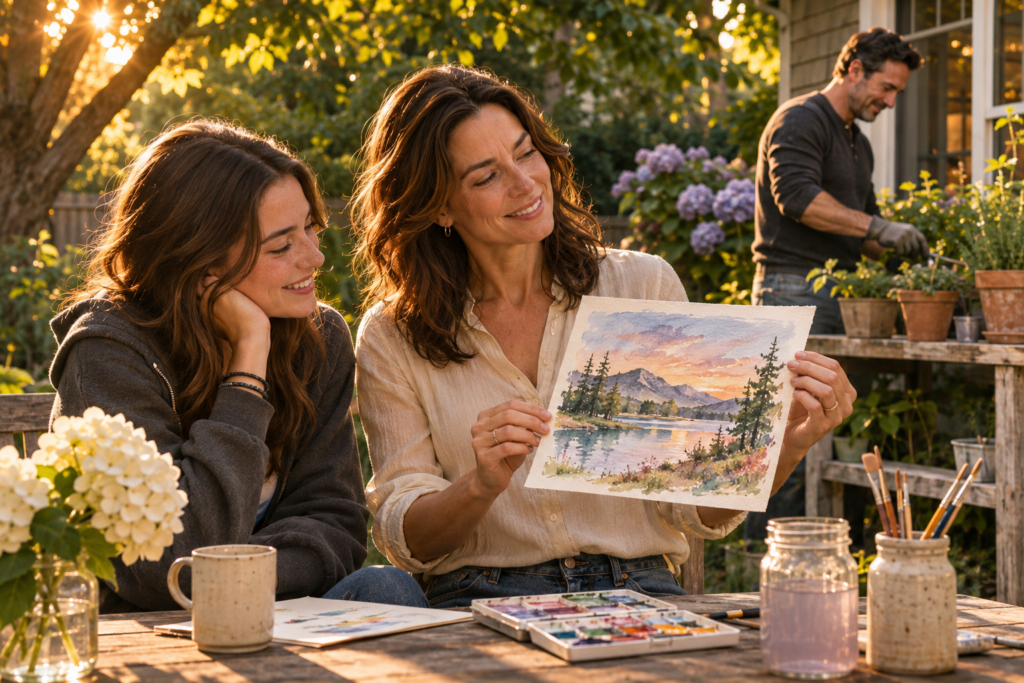
The following Sunday, Rachel brought her painting home.
Sophie insisted on hanging it in the hallway.
Her husband smiled when he saw it.
“You should do that more often,” he said.
Rachel looked at the crooked little landscape.
“I think I will.”
Nothing about her life had dramatically changed.
She still had the same home, the same family, the same responsibilities.
But now, Tuesday evenings belonged to her painting class.
And that small piece of time made something else feel possible.
Rachel hadn’t needed to abandon the life she’d built.
She’d needed to remember that she was still allowed to grow inside it.
Rachel’s story offers an important distinction:
Being grateful for your life doesn’t mean you have to stop wanting something more from it.
Try this simple Fulfillment Check-In.
1. Notice what feels missing.
Is it creativity, friendship, adventure, quiet, learning, connection, or something else? You don’t need to justify the answer.
2. Remember what used to make you feel alive.
Think about interests, activities, or experiences that once brought you genuine enjoyment. Which still appeal to you today?
3. Make room for one small thing.
Choose an activity you can realistically return to or explore. It might be a weekly class, a monthly outing, or thirty minutes devoted to something you love.
Not every feeling of dissatisfaction has a simple solution, and persistent emptiness can sometimes deserve additional support.
But asking what matters to you is a worthwhile place to begin.
Rachel didn’t need to feel guilty for wanting more.
She could love the life she’d created and still make space for the woman she was becoming.
A good life doesn’t have to be a finished life. You’re still allowed to discover new parts of yourself.
Part of The Strong Woman’s Reset — a 21-day journey toward reclaiming personal time, practicing boundaries, and building a life that includes your needs.